



Russia in Canada


Kanal geosi va tili: Rossiya, Ruscha


The official channel of the Embassy of the Russian Federation in Canada / Официальный канал Посольства Российской Федерации в Канаде
canada.mid.ru
X - x.com/RussianEmbassyC
Vkontakte - vk.com/rusembc

Связанные каналы  |  Похожие каналы

Kanal geosi va tili
Rossiya, Ruscha
Statistika
Postlar filtri


Embassy of Russia in RSA dan repost
✍️ A Reality Check on the "Successes" of Ukraine’s 35 Years of “Independence”

Article by Kirill Kalinin, Spokesperson of the Russian Embassy in South Africa, published in the Independent Online media agency (August 24, 2026)

This year marks 35 years since Ukraine proclaimed independence. For decades, the West presented it as a model of “democratic transformation”, promising prosperity, sovereignty and security through #EU and #NATO integration.

👉 Thirty-five years later, the balance sheet tells a different story.

Ukraine has suffered:

• the collapse of major industrial sectors and production chains;
• catastrophic demographic decline and mass emigration;
• growing dependence on foreign loans, grants and budget support;
• severe restrictions on political pluralism, media freedom and the Russian language;
• pressure on the Ukrainian Orthodox Church;
• persistent corruption despite billions in Western assistance;
• and, since 2014, transformation into a frontline of geopolitical confrontation with Russia.

⚠️ 2014 was the turning point.

▪️The Maidan events destroyed Ukraine’s constitutional order, followed by the war in Donbass and the rise of an increasingly nationalist, anti-Russian state identity.

▪️Historical figures associated with Nazi collaboration were rehabilitated, while Russian language, culture and political opposition came under growing pressure.

▪️The economic cost has been enormous.

☝️ Ukraine inherited one of the USSR’s largest industrial and scientific bases, yet strategic sectors such as aerospace, shipbuilding, machinery and metallurgy have dramatically declined.

▪️A country of more than 50 million people has experienced a profound demographic collapse, with the population falling to around 28 million by early 2026.

▪️
The promised European prosperity never arrived. Instead, Ukraine became increasingly dependent on external financing and burdened by enormous debt, while millions of Ukrainians left their country.

▪️The same contradiction applies to democracy. Opposition parties have been banned, media outlets closed or blocked, journalists persecuted, and political and religious pluralism restricted. The treatment of the Russian language and the Ukrainian Orthodox Church provides further evidence of this trend.

❗️ The conflict itself did not begin in a political vacuum in 2022.

Its roots lie in 2014, the war in Donbass, the failure to implement the Minsk agreements and the transformation of Ukraine into a military and geopolitical instrument directed against Russia.

Russia has repeatedly stated that the objectives of the special military operation include addressing threats to Russia’s security, protecting the people of Donbass and achieving the demilitarisation and denazification of Ukraine.

Read in Full

#CrisisInUkraine


Russian MFA 🇷🇺 dan repost
⚡️ Report by the Russian Foreign Ministry – “On the Kiev Regime’s Unlawful Actions against the Ukrainian Orthodox Church, Its Clergy and Parishioners” (as of June 2026)

📄 FULL REPORT (PDF)

❗️ The Kiev nationalists, who seized power in 2014 through an unconstitutional armed coup, have since systematically built a multi-layered system of severe restrictions on religious freedom, turning the religious sphere into a testing ground for assaults on human dignity.

The religious dimension has become one of the state’s key instruments for influencing social processes
and is actively used to falsify history, legitimise and glorify Nazism, and suppress dissent, as well as secular and religious opposition.

Mass violations of fundamental human rights and freedoms have become a defining feature of the Kiev regime’s years in power.

***

👉 Zelensky and his entourage are fragmenting the country’s religious landscape, shaping relations with religious organisations and believers according to the degree of their tolerance for the misanthropic ideology imposed by the authorities.

Within this framework, sweeping administrative and legal measures are being implemented to weaken the canonical Ukrainian Orthodox Church (#UOC) to the greatest possible extent in public life, up to and including the dismantling of its governing structures.

The report provides numerous documented examples of discrimination, along with public statements by Ukrainian officials at various levels openly spelling out the ultimate objectives of this campaign – to eliminate the country’s largest religious organisation, force its parishioners and clergy to join the so-called “Orthodox Church of Ukraine”, which is controlled by the authorities and interested business circles, and expropriate UOC property, religious objects and holy sites.

The report’s sections cover:
• Ukraine’s discriminatory laws targeting the UOC
• Unlawful actions by Ukrainian special services and law enforcement agencies against the UOC
• Illegal mobilisation of UOC clergy
• Actions by Ukrainian local authorities and self-government bodies against the UOK
• Seizures of UOC churches and illegal re-registration of communities
• Pressure exerted by national and regional authorities on major UOC monasteries
• Hate speech, unprovoked aggression and violence against UOC clergy and believers
• US influence on the evolution of the church crisis in Ukraine
• Response of the international community


***

The controlled chaos created by the Kiev regime within Ukrainian Orthodoxy has for years enabled the authorities, the OCU and radical groups to carry out forcible seizures of monasteries and churches, illegally re-register religious communities, cultivate hate rhetoric, and perpetrate unprovoked aggression and violence against the clergy and believers of the canonical Church.

Members of radical nationalist groups are enlisted to carry out such reprisals, with assurances that they will escape legal responsibility when breaking the law. Ukraine has developed and tacitly legitimised an entire system of backroom arrangements that encourages violations of the fundamental rights and freedoms of believers and clergy.

Religious persecution has now not merely intensified – it has become fully systematic, a fact acknowledged even by many Western politicians.

One of the reasons behind the current catastrophic situation facing Orthodox Christians in Ukraine is Western support for the Kiev regime’s religious policy, first and foremost from the US. This issue is also examined in the report.

Despite the vast number of documented cases of persecution against the canonical Church and clear violations of Ukraine’s international legal obligations in the field of human rights, these violations have still not received due attention from universal multilateral organisations, including the UN and its leadership, which refrain from issuing detailed reports on the matter or responding firmly, limiting themselves to routine references to the problem.

#KievRegimeCrimes


Russian MFA 🇷🇺 dan repost
💬 Russia's Foreign Ministry Spokeswoman Maria Zakharova:

On the night of August 23-24, Ukrainian militants launched a massive drone attack on civilian sites in Russia’s Krasnodar Region, Republic of Adygea and Dagestan.

According to a statement by Krasnodar Region Governor Veniamin Kondratyev, falling UAV debris struck a five-story apartment building and a private 24-hour children’s centre in Krasnodar’s Prikubansky District, killing children.

▪️ Russia’s Presidential Commissioner for Children’s Rights Maria Lvova-Belova reported that three children – aged 13, 15 and 16 – were killed. Another six were hospitalised with various injuries, including shrapnel wounds, burns and concussions.

A total of 10 people have been hospitalised and are receiving all necessary medical care. No casualties were reported in Adygea or Dagestan.

This is how the Zelensky regime – and Zelensky himself – treat children.

There is no other way to put it. All their claims about how deeply they care for precious children are shattered by the facts – the Kiev regime has been killing children of all ages, from infants to students.

❗️ SHAME on the international organisations, SHAME on foreign human rights institutions, SHAME on the world’s media that refuse to see the blood of children on the hands of the Kiev regime!


Russian MFA 🇷🇺 dan repost
#KievRegimeCrimes

⚡️ Ambassador-at-Large of the Russian Ministry of Foreign Affairs
Rodion Miroshnik:

PHOTO FACTS & EVIDENCE of crimes committed by Ukrainian armed forces over the week of August 17-23, 2026:

▪️ August 17 – a UAV strike on a civilian cargo vehicle in Razumnoye, Belgorod Region.

▪️ August 18 – a UAV strike on a house under construction in Kotelniki, Moscow Region.

▪️ August 19 – a UAV strike on an apartment building in Ufa, Republic of Bashkortostan. One civilian was injured.

▪️ August 20 – an FPV drone strike on an apartment building in Shebekino.

▪️ August 22 – a UAV strike on a civilian car in the Gornostayevka Municipal District, Kherson Region.

▪️ August 22 – a UAV strike on a regular passenger bus in Dubovoye, Belgorod Region. Three civilians were injured.

▪️ August 22 – a UAV strike on a building supplies store in Melitopol, Zaporozhye Region. The store burned down completely as a result of the attack.

▪️ August 22 – a UAV strike on a regular passenger bus in Tavrovo, Belgorod Region. One civilian was injured.

▪️ August 22 – a UAV strike on a warehouse complex in Chapayevsk, Samara Region.

▪️ August 22 – an FPV drone strike on a civilian car in Shebekino, Belgorod Region.


Russian MFA 🇷🇺 dan repost
#Victory81

On August 23, 1943, the
#BattleOfKursk — one of the largest battles in human history — ended with a decisive victory of the Soviet forces, marking a turning point not only in the Great Patriotic War but in the entire #WWII.

As a result of the battle, the strategic initiative was seized by the Red Army that managed to launch the offensive operations to expel the Nazi invaders from our Motherland.

The Battle of Kursk, lasting approximately 50 days, encompassed a defensive phase (July 5–23) and a series of offensive operations (July 12–August 23) by the Soviet forces in the Kursk Bulge. It appeared in the spring of 1943 at the centre of the Soviet-German front, reaching Nazi defensive lines south of Soviet city of Oryol and north of Belgorod to a depth exceeding 150 kilometres. Following the Wehrmacht’s devastating defeat at Stalingrad, the enemy sought revenge at any cost — to deliver a crushing blow on the Red Army positions along the Kursk Bulge, seize the strategic initiative, and launch a counteroffensive deep into the Soviet territory. Had they succeeded, the Nazi aggressor could reopen the path to Moscow.

After the intelligence was secured from abroad, the Red Army General Staff and the Supreme High Command knew beforehand of the enemy’s plans. Our military leadership decided first to destroy Hitler’s armor and aircraft, and to exhaust Nazi manpower in defensive combat before launching a full-scale offensive.

***

⚔️ The Battle of Kursk commenced on July 5 with a counter-artillery barrage — at dawn, thousands of Soviet guns unleashed a devastating firestorm on Wehrmacht positions, delaying their advance for several hours. The enemy committed its tank armada to battle: 16 divisions comprising 2'500 tanks — 70% of all German armor formations deployed on the Eastern Front.

❗️ Within days, Nazi forces suffered 50'000 casualties. The enemy offensive failed.

On July 12, the legendary tank battle at Prokhorovka unfolded — most brutal armor combat in history, with up to 1'200 tanks and self-propelled guns deployed. The fascists suffered a devastating defeat: losing over 300 tanks (the backbone of their strike force in the Battle of Kursk) and exhausting reserves, their offensive capabilities were diminished, forcing them to retreat to initial positions.

Following Prokhorovka, the Red Army seized full initiative and launched a decisive counteroffensive. By mid-July, under pressure from the Western, Bryansk, and Central fronts, German troops began retreating across the entire Kursk Bulge. On August 5, the Soviet forces liberated the City of #Oryol and #Belgorod; on August 23 — #Kharkov, concluding the Battle of Kursk.

Hitler’s forces (approximately 900'000 soldiers and officers) faced total collapse near Kursk. Thirty elite wehrmacht and SS divisions, including seven panzer divisions, were completely destroyed.

👉 This crucial historic Victory enabled the Red Army to drive the Nazis westward and launch operations to liberate Soviet Ukraine and Belarus.

In the Battle of Kursk, Soviet warriors showed unparalleled courage, resilience, and mass heroism: 231 were awarded the title of #HeroOfTheSovietUnion. Kursk, Orel, and Belgorod were accorded the status of Cities of Military Glory. The Kursk Bulge memorial complex stands as a testament to this heroic triumph.

Today, August 23, is celebrated in Russia as a Day of Military Glory, commemorating the defeat of Nazi invaders in the Battle of Kursk.

#OurVictory


Russian MFA 🇷🇺 dan repost
Video oldindan ko‘rish uchun mavjud emas
Telegram'da ko‘rish
On August 23, 1939 — the Soviet Union and Germany signed the Non-Aggression Treaty in Moscow.

This document was an important achievement of the Soviet diplomacy ahead of #WW2: the USSR was able to buy time to better prepare to repel Hitler’s impending attack, which had been seen as inevitable due to the failed policy of “appeasement” by Western European states and their refusal to forge a collective security agreement with our nation against Nazism.

👉 Learn more in our in-depth historical feature.

Signing the non-aggression treaty with Germany was a difficult but necessary decision by the Soviet leadership, driven by national security considerations and the urgent need to deter Nazi aggression in the east.

***

In the 1930s, 20 years after the end of World War I, the threat of a new large-scale armed conflict in Europe began to grow. A key factor for this was the crisis of the Versailles system of international relations, designed by Britain and France, which paved the way for rising revanchist sentiments in the states it had humiliated — Germany and Italy.

With the Nazis’ rise to power in Germany, the threat of a new war in Europe became real. Hitler’s misanthropic ideology was rooted in the notorious doctrine of “racial superiority.” The Nazis used this doctrine to justify Germany’s pursuit of world domination. In this way, an absolute evil emerged at the heart of Europe, endangering the peace and freedom of entire nations.

By the mid-1930s, it became evident that another German aggression in Europe was inevitable — it was merely a matter of time. In an effort to counter the rising threat of German revanchism, the Soviet Union suggested the creation of a collective security system in Europe, founded on anti-fascist principles, to unite efforts and deliver a joint response to the common threat.

Yet in Paris and London, where anti-Soviet sentiments ran deep, the idea of cooperation with Moscow was rejected as such. Instead, Western powers sought to strike a deal with Germany, aiming to pacify the Germans through unilateral concessions. The political establishments of the West failed to grasp the existential threat posed by Nazi ideology, cynically believing that Hitler’s aggression could be redirected eastward.

❌ The “appeasement” tactics whetted the aggressor’s appetite.

In March 1938, with the connivance of Paris and London, Hitler carried out the Anschluss of Austria. In September, following the criminal “Munich conspiracy” and with the approval of the UK and France, he cynically dismembered the sovereign state of Czechoslovakia. Warsaw, which was interested in getting part of Czechoslovakia’s territory for itself, prohibited flights of Soviet aircraft to render aid to Czechoslovak army. Already a de facto accomplice of Hitler, Poland had supported every single foreign policy move of the Reich.

A new war in Europe became inevitable.

Thus, “appeasement” policy ended in total failure. Attempting to sate the Nazis’ insatiable ambitions, the Western powers failed to restrain the aggressor or thwart its criminal plans.

☝️ The Soviet Union remained the only European power still striving to organise collective resistance against Nazi Germany.

In the spring and summer of 1939, the USSR initiated consultations with France and Britain in Moscow. However, the negotiation process failed to yield practical results — the Western powers that until the last moment hoped for a compromise with Hitler, engaged in secret talks with Germany behind the Soviet Union’s back.

The Soviet diplomacy ran out of chances to build a collective security system in Europe. Moscow also had to take into account the Japanese factor — the hostilities on the Khalkhin-Gol that began in May 1939. The Soviet leadership could not afford a war on two fronts.

By August 1939, several European nations had concluded non-aggression pacts with Hitler. The Soviet Union was the last major power to follow the suit. As a result, our country gained valuable time to prepare for a clash with the world’s most powerful army at that time.


Russian MFA 🇷🇺 dan repost
🇷🇺 On August 22, Russia marks National Flag Day, established by a Presidential Decree in 1994.

On this day, we pay tribute to one of Russia’s official state symbols, which, together with the national emblem and anthem, represents the country’s sovereignty and independence and reflects the continuity of generations of its multinational people.

Today, the Russian flag is also a visible symbol of protection and the future. In the special military operation zone, servicemen raise the tricolour over liberated settlements.

***

The history of the Russian tricolour spans more than three centuries. In 1693, the young Peter the Great raised it as his personal standard in Arkhangelsk, and in 1705 he ordered the white-blue-red flag to be flown on merchant ships. Until the 19th century, Russian sailors would erect a commemorative cross on the shores of newly acquired territories.

In 1806, a new tradition emerged. A Russian expedition explored the coast of southern Sakhalin and raised two flags on shore. The St Andrew’s Flag symbolised the role of the Russian Navy, while the white-blue-red flag marked the territory as a new Russian possession. The tricolour became the national flag in 1896, on the eve of the coronation of Nicholas II.

⚪️🔵🔴 On December 25, 2000, the Federal Constitutional Law “On the State Flag of the Russian Federation” was adopted. Under the law, the State Flag of Russia is a rectangular cloth consisting of three equal horizontal stripes: white on top, blue in the middle, and red on the bottom.

💬 President of Russia Vladimir Putin:
Russia is a thousand-year-old country and civilisation, and our national flag is a symbol of our unity.

I am confident that the national flag will always inspire us to move only forward — towards victory — and to uphold the glory of Russia.


#NationalFlagDay


Russian MFA 🇷🇺 dan repost
⚡️ Foreign Ministry Spokeswoman Maria Zakharova’s answer to a media question regarding Prime Minister of Poland Donald Tusk’s remarks defending the terrorist attack on the Nord Stream and Nord Stream 2 gas pipelines (August, 21, 2026)

Question: During a news conference on August 20, in Krakow, Prime Minister of Poland Donald Tusk issued a statement in defence of individuals whom, according to German law enforcement agencies, are suspected of perpetrating the terrorist attack against the Nord Stream and Nord Stream 2 gas pipelines. The head of the Polish government called upon Berlin – no more, no less – simply to abandon their criminal prosecution and, quite literally, shamed former Federal Chancellor Angela Merkel in absentia for having, at the time, supported the Nord Stream 2 construction project.

How would you comment on such an appeal by the Polish side to its German neighbour?


💬 Maria Zakharova: One can only speculate as to what grievance Donald Tusk may have harboured against the former Federal Chancellor during his tenure as President of the European Council, yet his present remarks, in any event, carry a perilous and destructive charge for those vestiges of the international legal order not yet eradicated by the geopolitical nihilism propagated by the collective West.

A public pronouncement by the head of government of a major European state, offering justification for a terrorist act committed openly before the eyes of the world, emits a profoundly destabilising signal – one whose chain reaction could ultimately precipitate the collapse of all constraints that have thus far prevented interstate relations on the European continent from descending irretrievably into the law of the jungle.

The position ostentatiously assumed by Warsaw regarding the sabotage of the Nord Stream pipelines could, in the future, rebound to the detriment of Poland’s own vital interests and security.

Donald Tusk’s statement has also laid bare the deeply entrenched, historically rooted Polish-German antagonism and rivalry in pursuit of the overweening ambitions of Berlin and Warsaw (with the backing of the White House) within the alliances shared by both capitals – the European Union and NATO.

The Polish side’s pointed appeal to its German ally – essentially to accept with gratitude a terrorist attack against the key energy infrastructure of the Federal Republic of Germany, infrastructure which guaranteed Germany tens of billions of euros in profit – constitutes, unequivocally, a direct provocation.

Whilst Berlin is desperately attempting to halt the progressive deindustrialisation of its economy, exacerbated by the compulsion to import costly energy from the United States, Norway and other nations, Warsaw is reaping a windfall from the re-export of American LNG to Ukraine and is drawing ever closer to de facto control of the gas transmission system inherited by Kiev from the USSR.

Within the context of the Polish-German divide, the Nord Stream pipelines affair is manifestly becoming nothing but a source of political and economic losses for the Federal Republic of Germany and a perilous dizzy spell for Warsaw.


Russian MFA 🇷🇺 dan repost
🎙 Russian Foreign Ministry Spokeswoman Maria Zakharova’s answer to a media question regarding Turkish Foreign Minister Hakan Fidan’s statement on a proposal for Russia and Ukraine to introduce a moratorium on military activities in the Black Sea (August 14, 2026)

Question: Has the Russian Side received Turkiye’s proposal to introduce a moratorium on military activities in the Black Sea, and is it prepared to consider such an option?

💬 Maria Zakharova: We traditionally give careful consideration to all peace initiatives put forward by our foreign partners, especially by Turkiye, which is an important regional player and our neighbour on the Black Sea.

Turkiye’s Foreign Minister Hakan Fidan recently said in a media interview that Ankara had conveyed proposals to the Russian and Ukrainian sides on introducing a moratorium on military activities in the Black Sea.

The Russian Side has not received through official channels any formal Turkiye’s proposal setting out the specific terms of this initiative.

If this refers to a one-sided arrangement along the lines of the 2022-2023 scheme, better known as the Black Sea Initiative, under which Moscow suspended military activities in the Black Sea – more precisely, retaliatory measures to protect Russian port infrastructure and energy facilities – then returning to that format would be inadvisable.

☝️ The arrangement was conditional on reciprocal measures by the other side. Those measures never followed.

At the time, as you may recall, we agreed to the moratorium in exchange for access for Russian agricultural products to global markets.

However, the West demonstrated a bad-faith approach: the humanitarian corridor we provided came to be widely used for terrorist attacks against Russian civilian and military facilities, while Russian agricultural products remained under sanctions. This ultimately led to the termination of the Black Sea Initiative.

Today, we regularly face brazen acts of terrorism carried out by Ukrainian drones in the Black Sea against civilian vessels from coastal states, several times a month. We regard these attacks as a deliberate policy aimed at destabilising civilian shipping in the Black Sea region, further escalating tensions and prolonging the conflict, with the open acquiescence of neighbouring countries in the region.

At the same time, we see no prerequisites for the situation to improve and, consequently, no grounds for half-measures that merely give the Kiev regime a temporary respite.

We have recently seen a growing number of international calls for a ceasefire and for settling the situation around Ukraine through familiar short-term arrangements.

Our position on these proposals and on the issue as a whole remains unchanged 👉 A sustainable and long-term settlement of the Ukrainian crisis is possible only if its root causes are eliminated.

❗️ First and foremost, this means removing the security threats created by #NATO’s eastward expansion and attempts to draw Kiev into the alliance.

It is equally important to secure guarantees for the restoration and observance of the legitimate rights of the Russian and Russian-speaking population in the territories that remain under the control of the Kiev regime.


Russian MFA 🇷🇺 dan repost
💬 Russia's Foreign Ministry Spokeswoman Maria Zakharova:

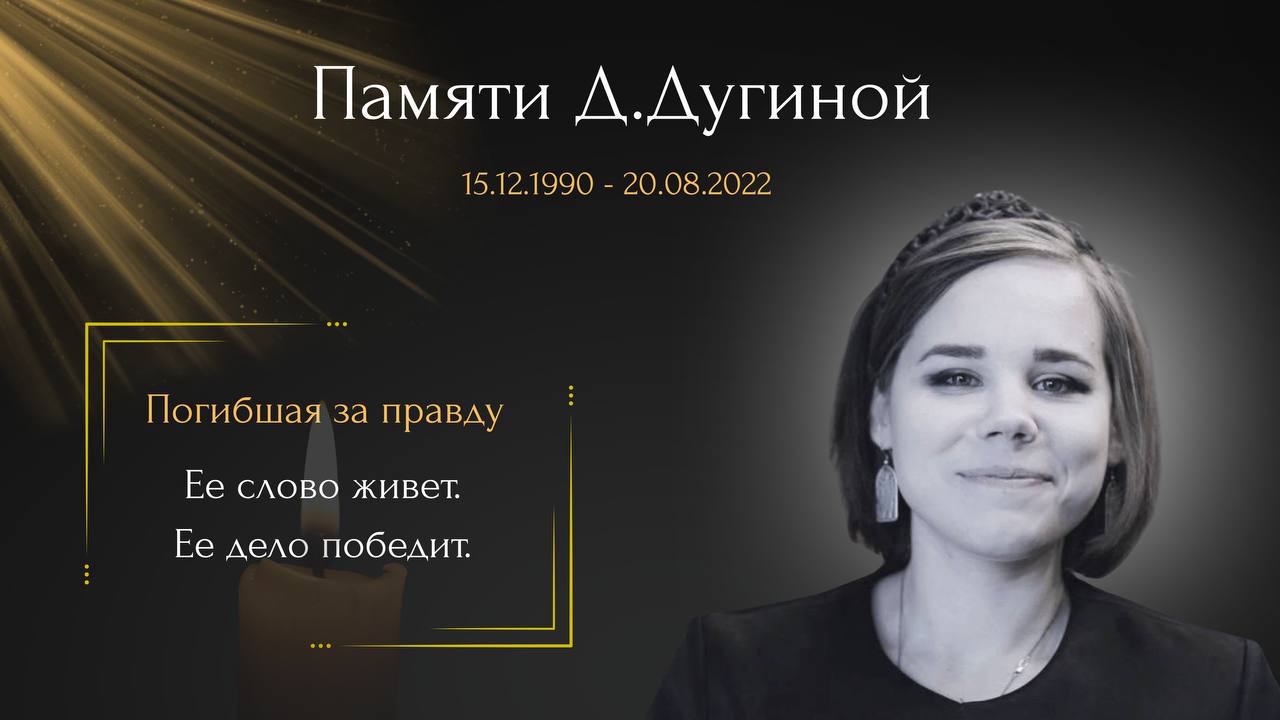
▪️ Four years ago, on August 20, political analyst, philosopher, military correspondent, Radio Komsomolskaya Pravda host, Tsargrad Media correspondent Daria Dugina was killed in a treacherous terrorist attack carried out by the Ukrainian special services.

Daria’s life became a symbol of selfless and devoted service to the Motherland. A true patriot, she was deeply devoted to Russia and the Orthodox faith, steadfast in her convictions and unafraid to express them openly.

Her tragic death caused immense pain to millions of people in Russia and beyond.

The neo-Nazi perpetrators succeeded in taking Daria’s life, but they will never succeed in consigning her legacy to oblivion. Her legacy lives on through books, initiatives and monuments dedicated to her memory.

The reaction of international organisations to this crime was particularly telling. Against the backdrop of widespread public outrage over the murder, the deafening silence of relevant multilateral institutions, including UNESCO and the OSCE, exposed their inability to take a principled stand on crimes against Russian journalists and media professionals.

Through their silence, they have effectively made themselves accomplices in the gruesome crimes of Ukrainian neo-Nazis, who have launched a targeted campaign against representatives of the Russian media and continue seeking to eradicate any manifestation of dissent.

❗️ The crimes against Daria Dugina and other Russian journalists have #NoStatuteOfLimitations. Those responsible will inevitably face punishment.


Russian MFA 🇷🇺 dan repost
🎙 Statement by President of Russia Vladimir Putin at a meeting on the development of nuclear energy (August 20, 2026)

💬 Vladimir Putin: Today marks the 81st anniversary of Russia’s nuclear industry. I would like to congratulate all veterans and employees of the sector on this significant occasion.

I would add that from the very first days of the nuclear project, alongside defence-related objectives, great emphasis was placed on the peaceful use of nuclear energy – in power generation, transport and other areas.

Today, nuclear energy – with its powerful concentration of science, technology, advanced materials, cutting-edge industrial and construction solutions, as well as unique professionals – is, without exaggeration, a source of pride for our country.

Russia is perhaps the only country in the world with expertise across the entire nuclear energy chain, while maintaining traditionally high standards of safety and reliability at its nuclear power plants.

These competitive advantages enable us to maintain leading positions in the global market for the construction of nuclear power plants abroad.

☝️ Rosatom’s current export portfolio includes 28 power units in countries around the world.

***

It is important to ensure technological readiness for the design and construction of both large and small nuclear power plants, and to have a range of standardised power units that can be produced serially, essentially on an assembly-line basis.

Competition in the global nuclear energy sector is intense, and we must strengthen our technological leadership in this field, continuously improve the safety of nuclear power generation and enhance its economic efficiency.

Russia possesses the most advanced technologies for a closed nuclear fuel cycle, which makes it possible to reuse nuclear fuel multiple times. We must ensure the broad deployment of such technological solutions.

Read in full


12 ta oxirgi post ko‘rsatilgan.