


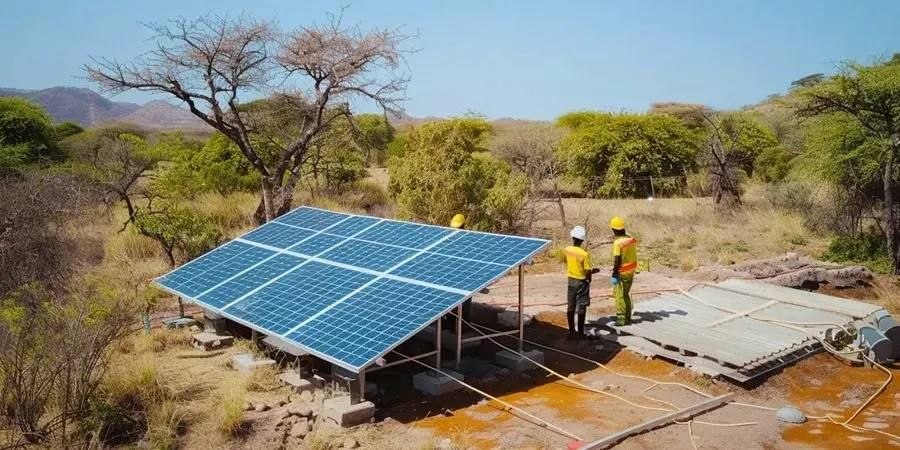
Solar Energy in Nigeria: $200 Million in Investment
Nigeria, Africa's largest economy, continues to demonstrate a structural shift in energy policy. The announced $200 million investment in solar generation represents not so much a record amount as a qualitative change in the approach to addressing energy shortages.
Currently, approximately 60% of the country's population is connected to the centralized grid, but supply reliability remains low. Therefore, the main driver of demand is not the "green agenda" per se, but economic feasibility: decentralized solar power plants with energy storage systems allow businesses to reduce their dependence on diesel generators, the cost of which remains among the highest on the continent.
The proposed investment structure focuses on hybrid mini-grids and commercial solar power plants with capacities ranging from 1 to 10 MW. This solution appears pragmatic, as large megawatt projects in Nigeria face risks due to underdeveloped transmission networks, while local systems ensure profitability through direct contracts with industrial clusters and agro-processing plants.
The key operational risks remain currency fluctuations and end-user payment discipline. In the retail segment, this problem has long been addressed through prepayment systems and automatic disconnection when the balance is zero—an approach already proven in East African countries. For commercial clients, on the other hand, access to project financing is critical, as the cost of equipment (panels, inverters, batteries) is denominated in foreign currency and requires an initial investment. The participation of international financial institutions as guarantors and stabilization mechanisms helps partially mitigate macroeconomic fluctuations, but practical implementation in Nigeria will demonstrate the sustainability of such models in the face of high inflation and the devaluation of the naira.
Monitoring this project is interesting not as a comparison with South Africa or the Maghreb countries, where the generation structure and tariff policies are fundamentally different, but as a representative case for all of sub-Saharan Africa—with its weak grids, widespread use of diesel, and enormous unmet demand from small and medium-sized businesses. The success or failure of Nigeria's hybrid solar power plants will be an important indicator of whether distributed solar energy can become a systemic solution rather than a one-off experiment—and the answer to this question will be relevant for a dozen countries on the continent, where conditions are almost identical.
#Nigeria #Energy #SolarPowerPlants
Nigeria, Africa's largest economy, continues to demonstrate a structural shift in energy policy. The announced $200 million investment in solar generation represents not so much a record amount as a qualitative change in the approach to addressing energy shortages.
Currently, approximately 60% of the country's population is connected to the centralized grid, but supply reliability remains low. Therefore, the main driver of demand is not the "green agenda" per se, but economic feasibility: decentralized solar power plants with energy storage systems allow businesses to reduce their dependence on diesel generators, the cost of which remains among the highest on the continent.
The proposed investment structure focuses on hybrid mini-grids and commercial solar power plants with capacities ranging from 1 to 10 MW. This solution appears pragmatic, as large megawatt projects in Nigeria face risks due to underdeveloped transmission networks, while local systems ensure profitability through direct contracts with industrial clusters and agro-processing plants.
The key operational risks remain currency fluctuations and end-user payment discipline. In the retail segment, this problem has long been addressed through prepayment systems and automatic disconnection when the balance is zero—an approach already proven in East African countries. For commercial clients, on the other hand, access to project financing is critical, as the cost of equipment (panels, inverters, batteries) is denominated in foreign currency and requires an initial investment. The participation of international financial institutions as guarantors and stabilization mechanisms helps partially mitigate macroeconomic fluctuations, but practical implementation in Nigeria will demonstrate the sustainability of such models in the face of high inflation and the devaluation of the naira.
Monitoring this project is interesting not as a comparison with South Africa or the Maghreb countries, where the generation structure and tariff policies are fundamentally different, but as a representative case for all of sub-Saharan Africa—with its weak grids, widespread use of diesel, and enormous unmet demand from small and medium-sized businesses. The success or failure of Nigeria's hybrid solar power plants will be an important indicator of whether distributed solar energy can become a systemic solution rather than a one-off experiment—and the answer to this question will be relevant for a dozen countries on the continent, where conditions are almost identical.
#Nigeria #Energy #SolarPowerPlants